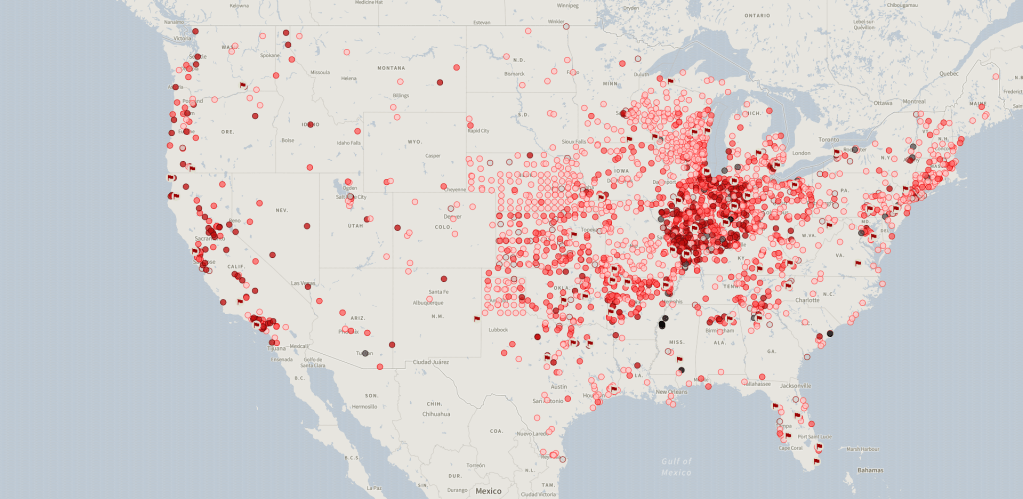
Loewen et al.,. Hosted by Tougaloo College, Tougaloo, MS.
For my dissertation, I am studying sundown towns – communities in the U.S. that between roughly 1890 and 1968 were intentionally exclusionary and violent against African Americans. They were often marked by signs that were posted at their municipal boundaries that warned African Americans to not be found in the area after dark, “or else”. Sundown towns were most prevalent in the Midwest, as the map above shows. This map relies on the primary data source of tracked sundown towns, developed by Dr. James Loewen. Research on this important topic has been growing in recent years.
If you’d like to learn more about sundown towns, I recommend you check out Loewen’s website. Dr. Loewen’s incredible work on this topic inspired me to explore it further. His passing in 2021 was a great loss for the research community.
My Dissertation Research
Building on Dr. Loewen’s foundational work, my dissertation examines sundown towns through an economic and institutional lens. Using restricted Census data and novel empirical methods, I investigate three key dimensions:
- Historical determinants – What factors led certain communities to adopt sundown policies while others did not?
- Economic consequences – How did these exclusionary institutions affect long-term economic outcomes for the communities that employed them?
- Contemporary legacies – In what ways do sundown histories continue to shape local policies and outcomes today?
A key contribution of my work is examining the varied institutional forms these exclusionary policies took across different communities – variations that prove important for understanding their emergence and impacts.
Published Book Chapter
Exploring the Persistent Effects of Racial Discrimination on Entrepreneurship and Growth

For an initial exploration of how discriminatory policies employed by sundown towns have shaped local communities across Illinois economically, check out my book chapter published by Rowman & Littlefield. This chapter shows how “sundown policies”, both formal and informal, functioned as an exclusionary barrier for African Americans to participation in economic life, therefore undermining two key ingredients for entrepreneurship to occur: the rule of law and property rights. Through this work, I also connect the literatures on institutional persistence and the economics of discrimination to the nascent, but growing literature on sundown towns.
My dissertation, forthcoming, significantly expands upon these themes using more comprehensive data and rigorous econometric methods. You can find my published chapter and the edited volume, Knowledge and Entrepreneurship in Public Policy, here.
 Olivia Gonzalez